What this guide covers
- Start with the category, not the container
- Use a six-measurement sheet
- Under-bed clearance diagram
- Match the container to the contents and the floor
- Plan one side for access, the other for low frequency
- Do not raise the bed just to rescue an unplanned purchase
- What should not go under the bed
- A reset that keeps the space honest
- FAQ
- Method notes
- Sources
Under-bed storage is useful only when the container clears the lowest obstruction, travels along a workable route, and holds a category you can realistically retrieve from floor level. Measure the bed at several points before choosing bins. Center supports, brackets, uneven flooring, a rug edge, or a low side rail can reduce the opening even when the space deeper under the mattress looks generous.
Start with the category, not the container
Write down what you want to move under the bed and how often it is used. Off-season clothes, spare linens, shoes, or luggage may be reasonable candidates when their care instructions and the room conditions allow it. Daily clothes, medication, important papers, frequently used cables, and anything sensitive to dust or moisture usually need a more accessible or controlled zone. If the proposed category is a mixture of unrelated overflow, sort it first using organizing without buying more bins.
- Measure height at the opening, center supports, and the full path the container will travel.
- Record usable width and depth on each side; do not assume the bed is symmetrical.
- Check the floor, rug, wall, bedside table, and your own kneeling or lifting access.
- Choose rigid, soft, wheeled, or divided storage only after matching it to the contents and surface.
- Keep enough free space to clean and inspect beneath the bed.
Use a six-measurement sheet
| Measurement | Where to take it | Common mistake it prevents |
|---|---|---|
| Opening height | Floor to the lowest side rail, including rug thickness | Buying a bin that fits deeper inside but cannot enter |
| Lowest internal height | Floor to center support, bracket, or slat hardware | Jamming a rigid lid under a hidden obstruction |
| Usable depth | Bed edge to the first leg, wall, or cross support | Choosing a box that cannot slide fully into place |
| Usable width | Between legs and supports on the chosen side | Assuming mattress width equals storage width |
| Pull-out route | Bed edge into the room, including table and door clearances | Creating storage that cannot be opened without moving furniture |
| Handling reach | How far you can comfortably pull, lift, and return the filled container | Overfilling a deep box that becomes impractical at floor level |
Measure in at least three places along the intended route. Floors and frames are not always perfectly level. When comparing international product listings, record inches and centimetres: 6 inches is about 15.2 centimetres, while 8 inches is about 20.3 centimetres. Do not round a close fit upward; use the exact product dimensions and leave a handling margin appropriate to the floor and container.
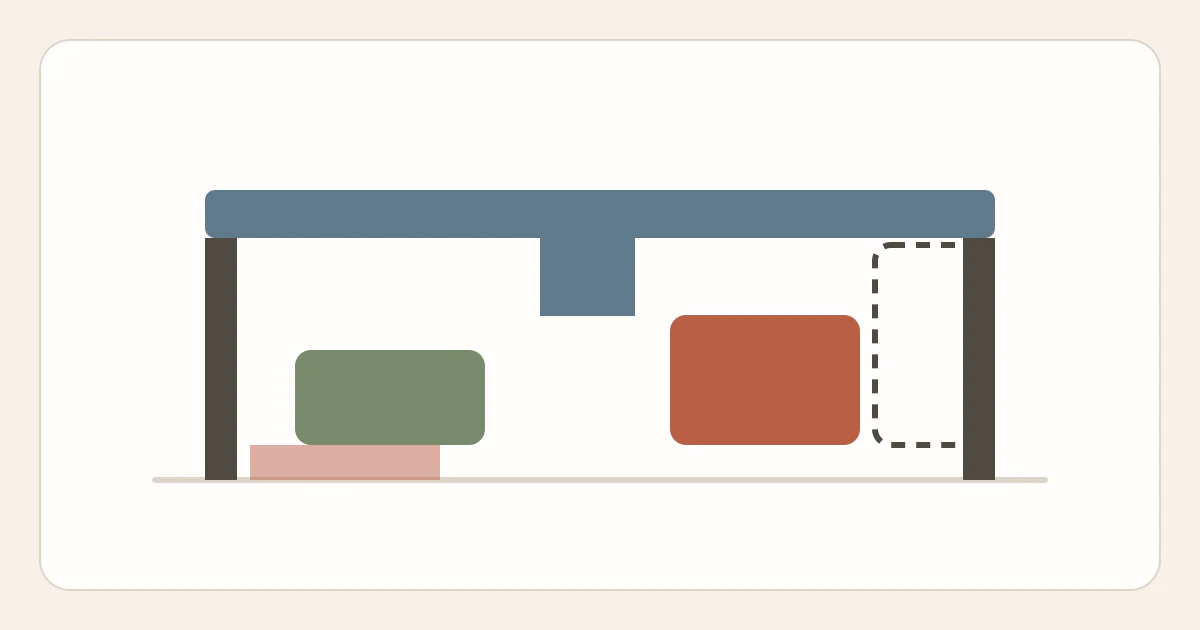
Under-bed clearance diagram
The green profile passes the opening and the center support. The terracotta profile fits the side opening but reaches the lower support. The outlined profile is already too tall at the entrance. Real beds may have more obstructions, so trace the entire route.
Match the container to the contents and the floor
Rigid lidded bins
A rigid bin protects its shape and can be easier to stack outside the bed when empty, but it cannot flex around a low rail. Check the outside dimensions, including lid clips, handles, wheels, and any raised rim. A large box encourages mixed contents and becomes heavy; two smaller categories may be easier to retrieve than one deep container.
Soft zippered cases
Soft cases can suit clothing or bedding when the item’s care instructions allow that form of storage. Their listed height may change when overfilled, so pack one test case and measure it again. A zipper is not proof of moisture or pest protection. Do not pack damp textiles, and do not place a fabric case in a zone with condensation, a leak, or a routinely damp floor.
Wheeled boxes
Wheels reduce dragging on a hard, smooth floor and can help with frequent access. They also add height and may struggle across a thick rug edge or uneven boards. Confirm that the wheels roll in the direction you need; some low boxes move easily lengthwise but are awkward to steer sideways.
Divided shoe or accessory cases
Dividers keep a single category visible, but fixed cells may waste space when shoe heights or accessory sizes vary. Measure the contents as well as the case. If the case must be fully removed to reach one pair, reserve it for occasional footwear rather than daily shoes.
Plan one side for access, the other for low frequency
In a bed against a wall, only one long side may be usable. Give that side to the category accessed most often. Push seasonal or rare items toward the head or wall side only when they can still be removed without lifting the mattress or crawling under the frame. Do not use storage to make a blocked side feel like capacity when the items cannot be retrieved normally.
If luggage is the main category, measure the wheels, handles, and shell in the stored orientation and use where to store luggage in a small apartment. A soft duffel might share a low zone with packing cubes, while a rigid case may need the entire route. For bedding, compare the under-bed plan with a frequency-based linen closet layout; the linen closet may remain better for frequently changed sheets even if the bed has more volume.
Do not raise the bed just to rescue an unplanned purchase
Bed risers change bed height, access, stability, and the load path through the legs or frame. Use them only when the bed and riser manufacturers explicitly support the combination and the floor is suitable. Do not stack improvised blocks, add risers to unsupported leg shapes, or assume a dorm-style solution works with an upholstered, platform, adjustable, or storage bed. If more height is essential, evaluate the bed system as furniture rather than treating the riser as a storage accessory.
After choosing a container, repeat the route test with only part of the category inside. Pull it out from the position you normally stand or kneel in, open it, remove one item, close it, and return it. If the sequence requires moving a nightstand or twisting an awkward load, reduce the contents or choose a more accessible zone before filling the box.
What should not go under the bed
- Anything damp, leaking, strongly scented, or showing signs of pests.
- Cleaning chemicals, medicines, or products whose labels require another storage condition.
- Important documents or electronics unless their storage requirements are clearly met.
- Everyday emergency items that need immediate, unobstructed access.
- Loose objects that roll into the center and make cleaning or inspection difficult.
- So much weight that the filled container cannot be removed and returned safely.
A reset that keeps the space honest
- Monthly: pull each frequently used container completely out, return stray contents, and clean the accessible floor according to its care instructions.
- At the change of season: swap categories only after reviewing what was actually used. Do not automatically replace one full bin with another full bin.
- Twice a year: inspect for moisture, dust buildup, pests, damaged zippers, cracked lids, or wheels that no longer roll.
- When furniture moves: measure again. A new rug, bedside table, or bed position can change the pull-out route even when the frame is unchanged.
FAQ
How much clearance should I leave above an under-bed bin?
Use a practical margin based on the actual route, lid, handle, floor, and how the filled bin moves. There is no universal gap. A rigid box on wheels may need more working clearance than a soft case, while a rug edge may reduce the usable opening.
Are vacuum bags a good under-bed option?
Only when the stored item’s care instructions allow compression and the bag remains suitable for the environment. Vacuum bags can make a soft load thinner, but they do not fix a damp zone, a blocked route, or an inaccessible category. Re-measure the packed bag because shape can become uneven.
Can I store books under the bed?
Books are dense and moisture-sensitive. A container may become too heavy to handle before it looks full, and a damp room can damage paper. Use a dry, accessible shelf when possible. If the under-bed zone is considered, keep the quantity small, confirm the environment, and test the filled weight rather than relying on volume.
Should containers fill the whole area under the bed?
No. Leave room to retrieve, clean, and inspect. Filling every square inch can turn usable storage into a concealed backlog. The goal is a small number of assigned categories, not maximum theoretical volume.
Method notes
The Start Here method is applied here as category first, measurements second, product last. The article does not rank containers or promise protection from dust, moisture, or pests. For the complete movement route used with larger furniture, see measuring furniture and its full access path; for more measurement-led systems, browse Small-Space Storage.
Sources
- IKEA, official under-bed storage guidance to measure height, width, and depth before purchasing — ikea.com/in/en/cat/under-bed-storage-19059
- U.S. Environmental Protection Agency, A Brief Guide to Mold, Moisture and Your Home — epa.gov/mold/brief-guide-mold-moisture-and-your-home
- U.S. Consumer Product Safety Commission, Anchor It! furniture stability guidance — cpsc.gov/Safety-Education/Safety-Education-Centers/AnchorItgov