What this guide covers
- First decide whether the balcony is a storage zone
- Measure the usable footprint, not the whole balcony
- A practical order that avoids buying the wrong box
- Balcony zoning diagram
- Four storage approaches, with their real trade-offs
- Write a specification before shopping
- What not to change yet
- A five-minute balcony reset
- FAQ
- Method notes
- Sources
Balcony storage can help a small apartment, but an outdoor corner is not simply an extra closet. Rain, sun, wind, drainage, the railing, the door swing, and building rules all affect what can live there. Begin by measuring the clear route and recording the conditions through a normal week. Only then decide whether the balcony needs a compact storage seat, a low cabinet, a freestanding shelf, or no storage at all.
First decide whether the balcony is a storage zone
Stand at the open balcony door and look outward before moving anything. The door must still open as designed. The route from the room to the balcony should remain easy to use, and any drain, inspection point, utility equipment, or secondary exit must stay visible and reachable. If the usable footprint disappears after those areas are protected, the balcony is not a good storage zone. That is a useful conclusion, not a failed project.
- Read the lease, balcony rules, and building notices before adding furniture or attachments.
- Protect the full door swing, walking route, drain, railing, and any required exit.
- Record direct rain, splash, sun, wind, and water movement instead of assuming the corner stays dry.
- Measure the item and the access path, including the open lid or door.
- Store only belongings suited to the actual conditions and their own care instructions.
Measure the usable footprint, not the whole balcony
| Check | What to record | Why it changes the plan |
|---|---|---|
| Access | Door swing, threshold, walking route, and retrieval space | A unit can fit the floor yet make the balcony awkward or unsafe to use |
| Water | Direct rain, splash, drip lines, pooling, and drainage route | Outdoor-rated does not mean suitable for every exposure or for blocking drainage |
| Sun and heat | Hours of direct sun and the hottest part of the day | Materials and stored belongings have different temperature and UV limits |
| Wind | Exposed corners and anything light enough to move | Loose lids, covers, and lightweight objects may need a different location |
| Rules | Lease, building policy, visible-item rules, and attachment restrictions | Permission and product suitability are separate questions; both must be satisfied |
| Use | How often the balcony and stored items are accessed | Daily items need a simpler reach than seasonal supplies |
A practical order that avoids buying the wrong box
- Remove indoor overflow. Bring unrelated bags, broken planters, empty cartons, and items awaiting another destination back inside for a decision. Use the same one-category-at-a-time approach as low-mess category decluttering; do not turn the entire living room into a sorting floor.
- Observe one ordinary weather cycle. Note where rain reaches, where water travels, and which surfaces become hot or remain shaded. A single dry afternoon does not describe the zone.
- Draw the keep-clear areas. Mark the doorway, route, railing, drain, and all building equipment. Do not count those areas as storage capacity.
- List only balcony-suitable contents. Gardening hand tools, an outdoor cushion only when its care instructions allow the planned storage, or a small amount of outdoor-use equipment may belong here. Paper records, electronics, medicines, food, cleaning chemicals, and moisture-sensitive textiles usually need a controlled indoor zone unless their labels explicitly allow otherwise.
- Group by access frequency. Put frequently used items near the opening side of a low unit. Reserve the back for lighter, occasional items that can be retrieved without emptying everything.
- Choose a form after measuring. Compare a low box, a narrow freestanding cabinet, and an open shelf against the same footprint, opening clearance, exposure, and building rules.
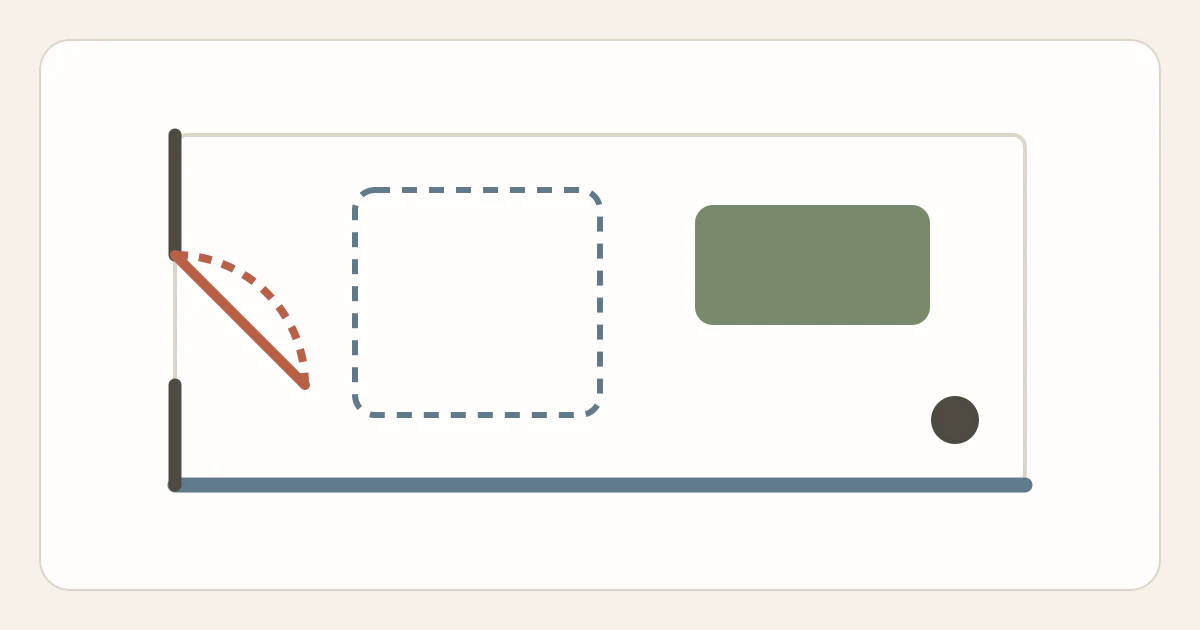
Balcony zoning diagram
The colored storage block is deliberately low and outside the door swing and central route. The diagram is a planning example, not a universal clearance rule; use the route and access space required by your household and building.
Four storage approaches, with their real trade-offs
1. A low outdoor storage box
A low box keeps the visual field open and can hold a small, defined category. Check the manufacturer’s outdoor-use statement, drainage design, ventilation guidance, closing mechanism, and care instructions. Measure with the lid fully open, not only closed. A box that doubles as seating should be used that way only when the manufacturer describes it as seating and states the relevant limits; a storage lid is not automatically a bench.
2. A narrow freestanding cabinet
A vertical cabinet can use a slim wall section, but height introduces wind exposure, access, and stability questions. Follow its placement and anchoring instructions. If the required anchoring conflicts with the lease or the wall cannot be identified confidently, choose another form. The same caution used in vertical storage without crowding the room applies outdoors even more strongly: height is useful only when the unit remains suitable for the surface, exposure, load, and retrieval method.
3. An open, outdoor-rated shelf
Open shelves make tools visible and allow you to notice water or dirt quickly. They also expose everything to weather and can look cluttered from inside the apartment. Use trays or containers only when those pieces are individually suitable for the conditions, and keep the total inventory small enough to inspect without unloading the entire shelf.
4. No permanent balcony storage
For a very narrow balcony, the best system may be an indoor tote that travels outside when needed. A gardening tote can live near the door, much like the landing zone in an entryway without a closet, and return inside after use. This preserves the balcony for light, air, and movement instead of creating a difficult second storeroom.
Write a specification before shopping
Turn the measurement sheet into a short specification. Record the maximum closed width, depth, and height; the required lid or door opening space; the item’s outdoor exposure rating; the contents it will hold; how they will be retrieved; and any lease or anchoring restriction. Keep measurements in both inches and metric when comparing products from different markets. For example, 24 inches is about 61 centimetres and 36 inches is about 91 centimetres, but use the product’s stated dimensions rather than rounding a close fit.
What not to change yet
- Do not attach a rail-hung shelf, planter, privacy screen, or cabinet until building rules and the exact product instructions permit that railing type and installation.
- Do not cover the floor with interlocking tiles or mats before confirming drainage, surface care, and lease requirements.
- Do not use an indoor bin merely because it has a lid; confirm the intended environment and material-care guidance.
- Do not place a tall or climbable unit beside a railing, especially where children may use the balcony.
- Do not turn the clear route into temporary overflow on laundry day or while unpacking deliveries.
A five-minute balcony reset
Once a week, return loose items to their assigned zone, check that the drain and route remain open, and look for standing water, movement, corrosion, cracking, or a loose lid. After strong wind or heavy rain, inspect sooner. If a unit has shifted, become unstable, or taken on water, unload it and follow its instructions rather than adding improvised ties, blocks, or wall fixings. At the change of season, reassess the contents: an item that survived summer shade may not suit freezing weather, and the reverse can also be true.
FAQ
Can I store cleaning products on an apartment balcony?
Only when the exact label permits the expected temperatures, moisture, sunlight, and storage location. Many products require controlled conditions or separation from heat and direct sun. A small balcony is also easier for children or pets to access than a locked indoor cabinet. When the label does not clearly support the zone, keep the product in an appropriate indoor location.
Is a waterproof deck box enough for cushions?
“Waterproof” or “weather resistant” should be checked against the exact product description and cushion-care instructions. Inspect the box after rain and do not store cushions while damp. If water can enter or condensation remains, move the textiles to a dry indoor location and address the moisture source rather than assuming the lid solves it.
Should balcony storage be low or tall?
Low storage is often easier to keep below sightlines and less exposed to wind, but suitability depends on the measured footprint, manufacturer instructions, railing position, and household access. A tall unit needs a more demanding stability and attachment review. Neither form is automatically correct.
How do I make a tiny balcony look less cluttered?
Keep one defined category, use one storage form rather than several mismatched containers, and leave visible floor around it. Reducing the inventory usually improves the view more than disguising a large amount of overflow. Browse Small-Space Storage for the same capacity-first approach indoors.
Method notes
This guide adapts the Start Here method to an outdoor apartment zone: measure access and exposure, protect non-storage functions, reduce the category, and only then select a form. It does not recommend a brand, promise weather protection, or treat “rental-friendly” as automatic permission. For attachment decisions, use rental-friendly wall storage checks; for a compact indoor landing zone when outdoor storage is unsuitable, see an entryway without a closet.
Sources
- U.S. Fire Administration, Make and Practice a Home Fire Escape Plan — usfa.fema.gov/gallery/escape-plan/make-practice-a-plan.html
- U.S. Consumer Product Safety Commission, Anchor It! furniture tip-over guidance — cpsc.gov/Safety-Education/Safety-Education-Centers/AnchorItgov
- U.S. Environmental Protection Agency, A Brief Guide to Mold, Moisture and Your Home — epa.gov/mold/brief-guide-mold-moisture-and-your-home
- Command™ Brand (3M), official FAQ distinguishing outdoor products and compatible conditions — command.com/3M/en_US/command/contact-us/faqs