What this guide covers
A 15-minute evening reset is a fixed-scope routine — a short pass over the surfaces and items that already have a home — not a promise that every home can be fully reset in exactly 15 minutes every night. The timer’s job is to keep the routine from quietly expanding into a deep clean; when it ends, the reset ends too, and anything left over moves to a later task list instead of stretching the routine longer.
Quick plan
- Set a timer and stop the reset when it ends, finished or not.
- Focus on visible, high-friction surfaces first.
- Only return items that already have an assigned home.
- Carry anything unfinished to a later task list rather than extending tonight’s reset.
- Use a backlog rule for nights when 15 minutes genuinely is not enough.
Check before you start
Reset versus deep-clean boundary table
| Task | Belongs in the 15-minute reset | Belongs on a later task list |
|---|---|---|
| Surface clutter | Return items that already have an assigned home | Deciding a home for an item that does not have one yet |
| Dishes | Load visible dishes into the dishwasher or a rinse-and-stack routine you already use safely | Hand-washing a full backlog or deep-scrubbing cookware |
| Floors | A quick visual check for obvious hazards or spills | Vacuuming, mopping, or moving furniture to clean underneath |
| Laundry | Moving a finished load out of a landing zone into its assigned spot | Starting a new wash cycle or folding a large backlog |
| Bathroom | Wiping a visible counter or returning items to their spot | Scrubbing tile, grout, or fixtures |
The decision process, in order
- Set a visible timer before you start. A kitchen timer, phone timer, or any countdown works; the point is a fixed, visible boundary rather than an open-ended sense of “for a while.”
- Start with your identified high-friction surfaces. These are the same one to three surfaces you noted above — often the same spots covered in a clear-kitchen-counter reset, if your kitchen counter is one of them.
- Return items only to homes that already exist. If something does not have an assigned spot, set it aside for a separate sorting session rather than deciding its home mid-reset; deciding storage homes under a ticking timer usually produces worse decisions than a dedicated session using the Start Here method guide.
- Do a kitchen and dish pass within your normal safe routine. Load visible dishes the way you normally would; this is not the moment to change your dishwashing method, try a new product, or handle anything unfamiliar. A quick, familiar pass is more reliable inside a timed window than an improvised one.
- Stop when the timer ends. Whatever is unfinished moves to the backlog rule below, not into extra time tonight.
- Log anything left over on a running task list. A single running list — paper or digital — keeps unfinished items from being forgotten without forcing them into tonight’s window.
Printable timer sequence
This sequence is designed to print cleanly or read easily on a phone. Adjust the exact minute splits to match your own high-friction surfaces from the check above.
| Minutes | Task | Stop rule |
|---|---|---|
| 0–3 | Clear and reset your first high-friction surface | Move on at 3 minutes even if it is not perfect |
| 3–6 | Clear and reset your second high-friction surface | Move on at 6 minutes regardless of progress |
| 6–10 | Kitchen and dish pass, within your normal routine | Stop loading or wiping at 10 minutes |
| 10–13 | Return any remaining items to their assigned homes | Anything without a home goes on the backlog list, not into a decision now |
| 13–15 | One-glance walk-through and a final surface wipe if time allows | Stop entirely at 15 minutes |
A small-home route diagram
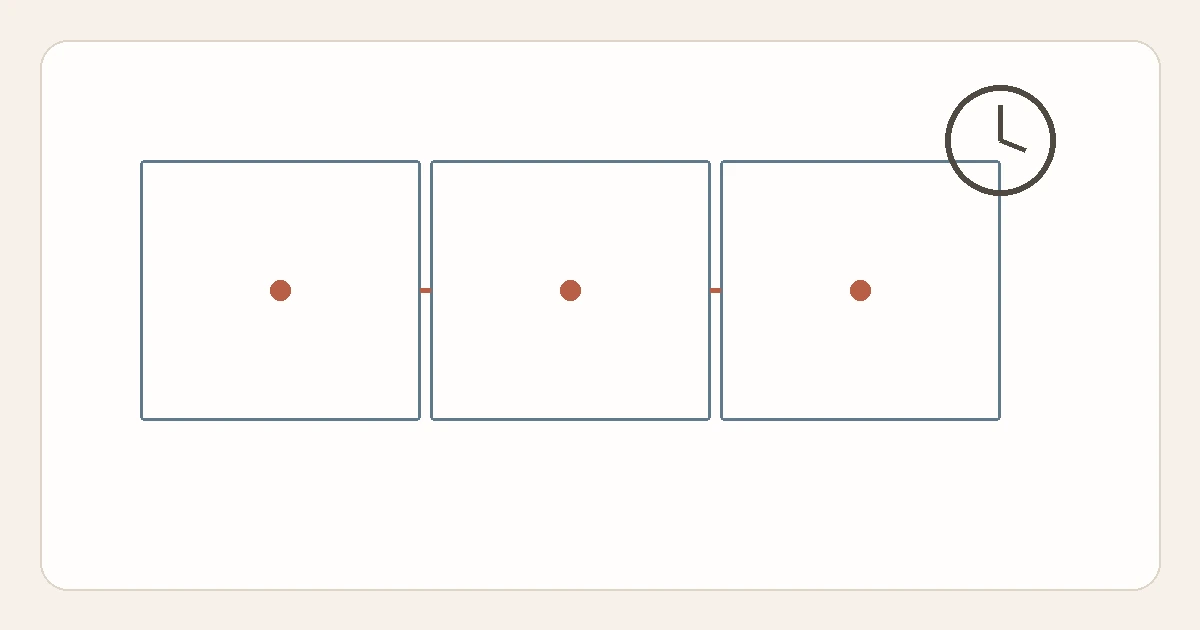
A fixed, short route through the same few spots each night is faster to execute than deciding where to clean on the spot. Adjust the rooms and order to match your own home’s actual high-friction surfaces.
A backlog rule for nights when 15 minutes is not enough
Some evenings the timer will end with more left than usual — guests earlier, a busier day, a bigger mess. Rather than extending the reset, move anything unfinished onto a single running backlog list and address it during a longer weekend session or the next available window. The reset’s job is to prevent the routine from silently becoming a deep clean every night; the backlog list is what prevents the same unfinished items from being forgotten entirely. Keep the backlog list in one consistent place — a notes app, a sticky pad, or a shared household list — so it does not become its own source of clutter. A backlog list that grows every single night, rather than occasionally, is itself useful information: it usually means the route or the time block needs adjusting, not that the household is failing at the routine.
What not to buy or change yet
- Do not buy a specialized timer or app before confirming a basic kitchen or phone timer works fine for this purpose.
- Do not buy new storage to solve an “items with no home” problem discovered mid-reset; note it for a dedicated sorting session using organizing a small apartment without buying more bins instead.
- Do not extend the reset past its timer as a habit; if 15 minutes consistently is not enough, adjust the route or the time block, rather than quietly letting the reset grow longer each night.
- Do not treat an unfinished reset as a failure that requires catching up all at once; the backlog rule exists specifically so a single busy night does not derail the routine.
A repeatable maintenance method
- Each night: run the sequence and stop at the timer, logging anything unfinished on the backlog list rather than pushing through past the stop point.
- Weekly: review the backlog list and address it during a longer session, separate from the nightly reset.
- Periodically: reassess whether your chosen high-friction surfaces and route still match where clutter actually accumulates, and adjust the printable sequence if they have shifted.
FAQ
What if my home genuinely cannot be reset in 15 minutes?
That is common and expected, especially at first. Use the same sequence structure with a shorter or longer time block that matches your real available window, and rely on the backlog rule for anything that consistently does not fit.
Should the sequence be the same every night?
A consistent route is usually easier to execute quickly, but adjust the order or the surfaces covered if your household’s actual mess pattern changes — for example, after a schedule change that shifts which room accumulates clutter fastest. Revisiting the route occasionally, rather than treating it as fixed forever, keeps the reset matched to how the household actually lives rather than how it lived when the sequence was first written.
Can I do this reset in the morning instead of the evening?
Yes — the sequence works at any consistent time of day; “evening” describes a common use case, not a requirement. Some households find a morning reset works better around a school or work schedule, while others prefer clearing the day’s accumulation before bed; either timing uses the same route and timer structure.
What if a task always ends up on the backlog list and never gets done?
That is a signal the task does not belong in a 15-minute reset at all — it may need its own dedicated routine, or a rethink of whether it is the right task for your household right now. See entryway storage when you have no closet for an example of assigning a task its own dedicated zone and schedule instead of folding it into a general reset.
Method notes
This guide applies the Start Here method guide to a fixed-duration routine: define the route, protect the boundary between reset and deep clean, and carry anything unfinished forward rather than letting the routine grow. It deliberately avoids claiming a specific wellbeing benefit, since a tidying routine’s effect on stress, sleep, or overwhelm varies by person and is not something this guide can measure or promise. Move the larger handoffs to the weekly small-apartment reset; browse Laundry & Cleaning for nearby routine-first chores.
Sources
This article describes a household routine-design method and does not make a chemical, appliance, or health claim that requires an external citation.