What this guide covers
- Quick plan
- Measure and check before you buy anything
- Constraints table
- The decision process, in order
- Cabinet-zone diagram with a keep-access-visible area
- Storage decision checklist
- Label, compatibility, and access worksheet
- Do not relocate yet
- What not to buy or change yet
- A repeatable maintenance routine
- FAQ
- Method notes
- Sources
Safe storage of cleaning products in a small home means keeping every product identifiable in its original labeled container, separating anything that should not sit near another product, and choosing a zone based on that product’s own label rather than whatever space is available. Maximizing storage capacity is a secondary goal here — label compliance and safe access come first, every time.
Quick plan
- Keep every product in its original container with the label intact.
- Read each label’s own storage directions before assigning it a zone.
- Never combine or store incompatible products in close, unseparated contact.
- Check shelf and cabinet stability before loading anything.
- Keep plumbing access and leak visibility protected if storing under a sink.
Measure and check before you buy anything
Constraints table
| Zone | Typical space | Access needed | Plumbing/utility visibility | Rental/property note | Best for |
|---|---|---|---|---|---|
| Under kitchen or bathroom sink | Split by the pipe run; see under-sink organization without blocking pipes or leaks | Daily to weekly for household adults | Must stay clear of pipes, traps, and shutoff valves | Applies to owned and rented homes alike | Products whose label does not restrict this location |
| High cabinet shelf | Whatever shelf your kitchen layout already has | Occasional, by design, for household adults | None specific | None | Products you want to keep less immediately accessible |
| Utility or laundry closet | Varies by home | Matches how often you clean or do laundry | Keep clear of any nearby water connection if present | None specific | Laundry-specific and general household products together |
| Lockable cabinet or container | Varies by product | Restricted, by design | N/A | Confirm any mounted hardware follows lease terms | Products you want physically restricted rather than just placed higher |
The decision process, in order
- Read every product’s label before sorting anything. Note storage temperature limits, “keep away from” instructions, and whether the label restricts a specific location such as under a sink.
- Identify products that must stay separated. Do not build a compatibility rule from memory. Follow each product’s label and a directly applicable authoritative source. OSHA/NIOSH specifically warns against mixing bleach-containing and ammonia-containing cleaning products; for other combinations, do not guess. This guide never recommends combining or mixing cleaning products.
- Match each product to a zone using its own label, not convenience. A zone that is easy to reach is not automatically the right one if the label specifies otherwise.
- Check shelf and cabinet stability before loading it. Confirm shelf pins, brackets, or clips are properly seated, and that the shelf or cabinet itself is not damaged, before adding weight; product-specific weight or capacity limits belong to that shelf or cabinet’s own manufacturer documentation. The same reach-and-stability thinking used in creating kitchen cabinet zones in a small kitchen applies here.
- Protect plumbing access if you are using an under-sink zone. The same keep-clear logic around pipes, traps, and shutoff valves applies here; do not let stored products hide plumbing access or leak visibility.
- Only then, consider an organizer, caddy, or lock. Measure the confirmed zone and your actual product count first, so anything you add fits the space and the household’s access needs.
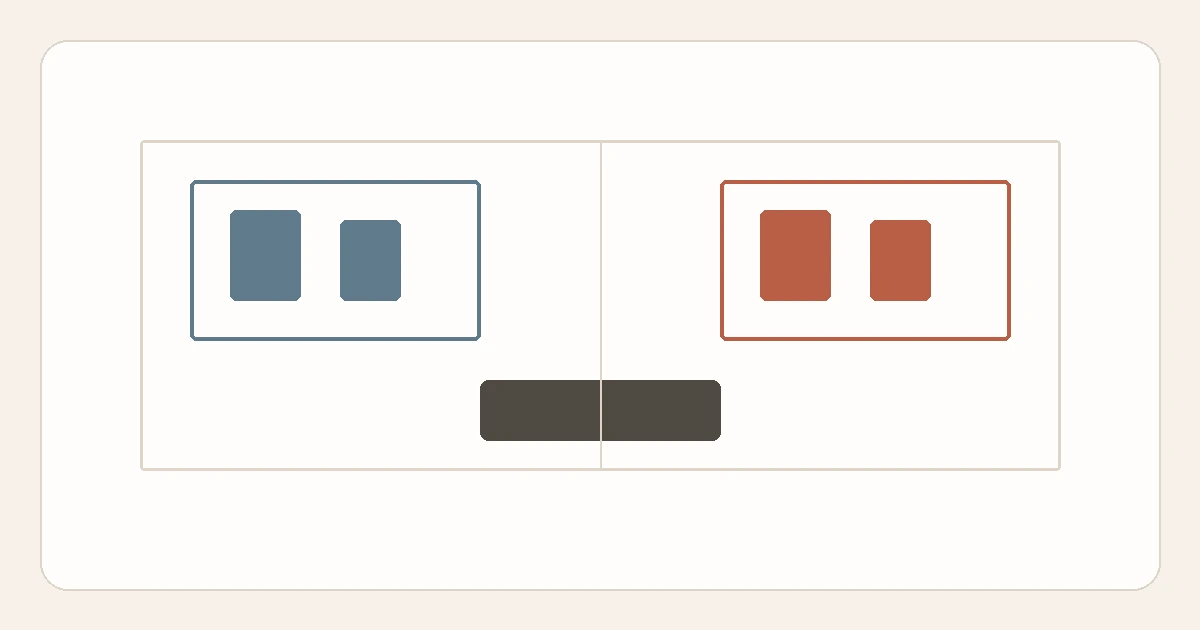
Cabinet-zone diagram with a keep-access-visible area
Two product groups sit fully separated with a visible gap between them, and a restricted-access container occupies its own zone below. The center gap stays open and visible so labels can be checked and leaks or spills spotted, rather than boxed in behind other items.
Storage decision checklist
Work through this checklist for each storage zone you are considering, in the same spirit as the plumbing-visibility checklist used for under-sink organization without blocking pipes or leaks.
- Every product’s label has been read for storage restrictions.
- Products that should not sit near each other are physically separated.
- Each product remains identifiable in its original, labeled container, with its closure secured as directed.
- The chosen shelf or cabinet is stable and not damaged.
- Household access matches who genuinely needs it, restricted where needed.
- Nothing blocks plumbing visibility if the zone is under a sink.
- A spill or leak from any container would be immediately visible, not hidden.
Label, compatibility, and access worksheet
This is a fill-in worksheet. Complete one row per product using its own label — do not rely on memory for the compatibility column.
| Product | Label storage restriction | Must stay separated from | Who needs access |
|---|---|---|---|
| Example: a bleach-containing cleaner already in your home | Copy the exact storage directions from that specific product’s label | Do not mix with ammonia-containing products (OSHA/NIOSH); add only other restrictions confirmed by that label or a direct authoritative source | Record the household access plan; do not rely on a universal height rule |
| Record your own product | Copy the exact storage line from that product’s label | Note only what that label or an authoritative source actually confirms — leave blank rather than guess | Note who in the household should have routine access |
| Record your own product | Copy the exact storage line from that product’s label | Note only what that label or an authoritative source actually confirms — leave blank rather than guess | Note who in the household should have routine access |
| Record your own product | Copy the exact storage line from that product’s label | Note only what that label or an authoritative source actually confirms — leave blank rather than guess | Note who in the household should have routine access |
Do not relocate yet
Before moving any product to a new zone, confirm the destination against that product’s own label — a move made for convenience can put a product somewhere its label actually advises against, such as near heat, near food, or near an incompatible product. If you are not certain a destination is appropriate for a specific product, leave it where it currently is until you have checked the label, rather than relocating it as part of a general reorganization.
What not to buy or change yet
- Do not buy a large multi-tier organizer before your label and access review is finished; some products may need to stay separated from others regardless of how much combined space an organizer offers.
- Do not decant any product into a beverage bottle, food container, or any unlabeled container, under any circumstance.
- Do not remove or obscure a product’s label to make it fit a display or organizer.
- Do not assume a lock or a high shelf makes a product fully inaccessible to a determined child; treat any access-restriction step as a layer of caution, not a guarantee.
A repeatable maintenance routine
- As part of your regular household reset: glance over the storage zone for any leaking, swelling, or damaged containers, and address anything you find by following that product’s own label.
- Whenever you buy a new product: read its label and complete a new row in the worksheet above before deciding where it goes.
- Whenever household composition changes — a new child in the home, a visiting relative, a new roommate — revisit the access column of your worksheet and adjust which zones are appropriate.
FAQ
Is it always safer to store cleaning products up high?
Height alone is not a guarantee of safety or of being out of a child’s reach, since children can climb, and this guide does not state a specific “safe” height. A higher shelf can be one layer of a broader approach that also includes supervision and, where appropriate, a lock — not a stand-alone solution.
Can I store cleaning products with food or food storage containers?
Keep cleaning products in a distinct, clearly identified storage zone rather than intermingling them with food or food-contact items, and follow any product-label separation instructions. EPA also specifically warns never to store household hazardous products in food containers. See organizing food containers and lids for organizing the food-storage side of the space separately.
What if two products have no listed incompatibility but I am still unsure?
When in doubt, store them apart rather than together. This guide does not attempt to list every possible product combination, since that would require verifying each pair against current authoritative sources rather than general assumption.
Is an under-sink cabinet a good default for most cleaning products?
Not automatically. Check the product’s own storage label first, then make sure the cabinet layout preserves plumbing access and leak visibility if you use that zone.
Method notes
This guide applies the Start Here method guide to the storage decision most in need of it: read the label first, separate anything uncertain, and protect stability and access over maximizing space. It deliberately does not include a homemade chemical-compatibility chart, a universal safe-height figure, or any treatment instructions, since all of these require verification against a specific product or a genuine emergency resource rather than general guidance. For more of Laundry & Cleaning‘s measurement-led approach to nearby storage decisions, browse the category directly.
Sources
- Occupational Safety and Health Administration and NIOSH, hazard information on mixing cleaning products containing bleach and ammonia — osha.gov/sites/default/files/publications/OSHA3512.pdf
- U.S. Environmental Protection Agency, household hazardous waste storage guidance (original containers and labeling) — epa.gov/hw/household-hazardous-waste-hhw